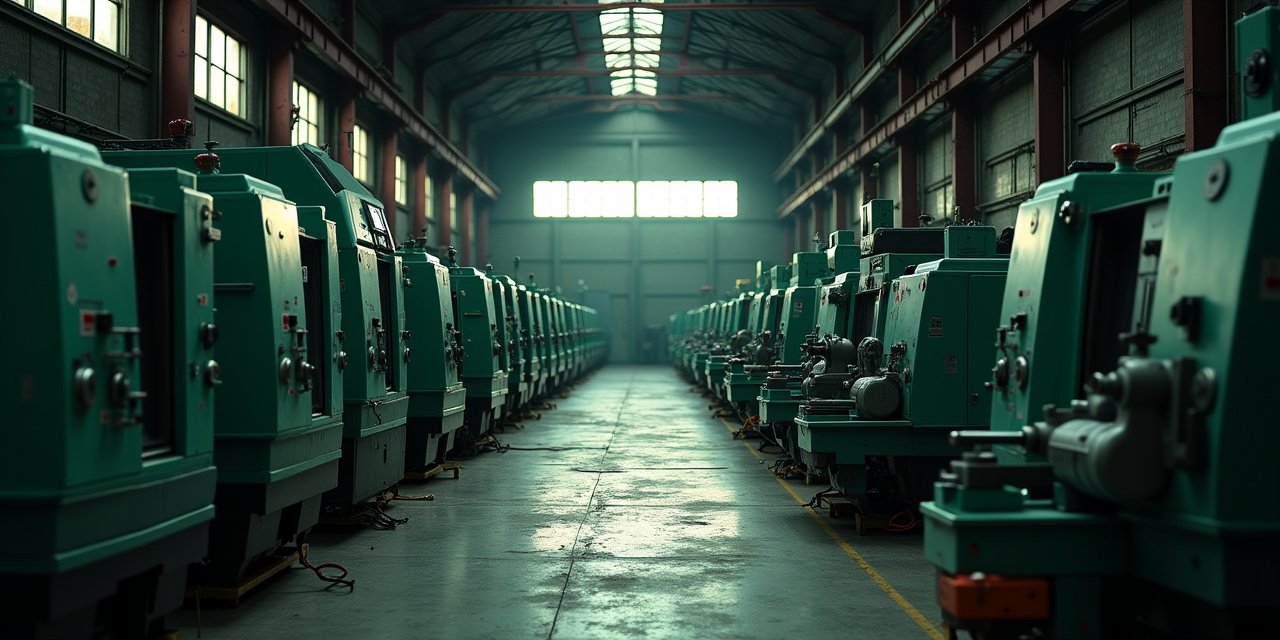
Cancelled EV and battery plants left machine tools sitting in warehouses. There is no line left to run them on.
A secondary market is now absorbing that capacity. Private equity roll-ups and search-fund buyers are among those buying.
So are manufacturers priced out of new equipment. More EV plants were cancelled in Q1 2025 than in 2023 and 2024 combined.
That's a real drop-off. It's according to the National Association of Manufacturers, and the pace continued through 2026.
Every cancelled project leaves behind equipment already ordered and financed. Some of it is already delivered, with no facility left to house it.
Buyers are stepping in. They take that capacity off distressed sellers' hands at a steep discount.
Billions in Reshoring Capacity Went Idle
Honda reportedly cancelled an $11 billion EV and battery plant in Canada. It is one of the largest single write-offs on record, per InsideEVs.
The plant was sized big. It carried a planned 240,000 vehicles and 36 gigawatts of battery-cell capacity a year.
Ultium Cells idled battery plants in Warren, Ohio and Spring Hill, Tennessee. More than 2,000 workers were affected across the two sites, per Energy-Storage.News.
Aspen Aerogels cancelled a $1 billion Georgia facility in February 2025.
KORE Power walked away from an Arizona battery plant, too. That came after it had already secured $850 million in conditional federal loan approval.
That's per NAM's tracker. Combined write-downs across Ford, GM, and Stellantis on EV programs alone exceed $53 billion.
That's per InsideEVs' reporting on the sector-wide retreat.
Where the Equipment Actually Goes
Some canceled-project equipment never gets fully installed and heads straight to industrial auction houses. Firms like Rabin Worldwide and Heritage Global Partners handle that flow routinely.
Perfection Industrial Sales runs close to 70 industrial machine auctions a year for clients. That's per its own auction listings.
That volume was already running before the reshoring pullback added supply.
Some capacity skips auction entirely. KORE Power and Ford's Tennessee plant both retrofitted existing facilities instead of building new ones.
That frees up equipment from the original EV-specific build-out. That gear re-enters the market through dealers and brokers rather than public auction.
Ford converted its Tennessee EV plant to gas-powered truck production. It hired 1,000 workers to boost F-150 and Super Duty output instead.
Why Buyers Prefer Used Right Now
New CNC machines from major Japanese and German builders carry long lead times. Six to eighteen months is typical, order to installation.
Steel and aluminum tariffs are pushing new-machine prices up further.
The ISM Prices-Paid Index hit 70.5 in February 2026, its highest reading since June 2022. That's per Premier Equipment's industry analysis.
Used machines already in the U.S. carry none of that tariff exposure. They were imported and priced before the current rounds took effect.
They also ship in weeks, not months. For a shop chasing a contract deadline, that gap alone can decide the purchase.
New vs. Secondary-Market Cost, by Machine Type
| Machine | 2026 New Price | Used Equivalent | Typical Discount |
|---|---|---|---|
| Citizen L20 Swiss lathe | $255,000-$290,000 | $55,000-$100,000 | 60-80% |
| Mazak QT-200 turning center | $130,000-$155,000 | $30,000-$65,000 | 55-75% |
| Haas VF-2 vertical machining center | $80,000-$98,000 | $20,000-$45,000 | 50-70% |
Private Equity Is Circling the Same Capacity
PE-backed roll-ups already dominate precision-machining consolidation. Audax's Solve Industrial Motion Group alone completed roughly 100 add-on acquisitions during 2025.
Trive Capital, AE Industrial Partners, and Industrial Growth Partners have each targeted precision suppliers too. That's per CT Acquisitions' 2026 tracker.
Platform-quality precision shops trade at 7 to 11 times EBITDA. Smaller add-on tuck-ins go for 4 to 8 times.
Certifications like AS9100 or ITAR move that multiple higher. Most of that activity still targets operating, going-concern shops, not raw equipment.
The same sponsors do have the balance sheets to absorb idle capacity, though. They tap it fast, when a platform company needs floor space.
A search-fund buyer starting from scratch shares that incentive. Discounted capacity simply beats waiting on a new-equipment order.
The Financing Angle Is Different From New-Equipment Deals
Financing a new equipment purchase and financing a distressed-asset acquisition are not the same transaction. A new-equipment purchase has a manufacturer invoice and a delivery date to underwrite against.
A secondary-market purchase needs an independent USPAP-compliant appraisal first. It must establish orderly liquidation value before a lender will advance against it.
That value sits well below fair market value by design. Lenders extending bridge financing for equipment purchases want that figure in hand first.
They use it to set the advance rate. Skip that step, and a term sheet comes back thinner than expected.
Auction-sourced equipment also arrives without a service history or warranty. That absence changes both the appraisal and what a lender will underwrite against it.
What This Means for Manufacturers Weighing the Trade
A manufacturer chasing a reshoring contract now faces a real choice. Order new and wait six to eighteen months.
Or buy secondhand capacity from a stalled competitor's project instead. The used option carries execution risk the new option doesn't.
Machines from a cancelled build-out may have zero run hours. Others sat uninspected in storage for a year or more, unmonitored.
An independent appraisal is meant to close that gap. So is a proper rigging and installation budget.
Skip either one, and a discount turns into a liability fast.
Next Move
This article reflects reporting and analysis as of September 2026. Figures cited are sourced as noted and subject to change.
Reshore Bridge is a lead generation service connecting operators with independent financing partners. It is not a lender, broker, or auctioneer. Not financial or investment advice.